Understanding Artificial Intelligence
through Algorithmic Information Theory
Introduction to
Subjective Probability
 You’re listening to the radio. It announces the last National Lottery draw: 1-2-3-4-5-6. You didn’t play. What are you likely to do?
Think about it. You’ll probably see it as big news*.
Will you refrain from tweeting it? Or looking for someone to tell?
*
On the 1st of December, 2020, South Africa’s lottery saw the numbers 5, 6, 7, 8, 9 and 10.
It made news around the world.
 You know you shouldn’t.
After all, you know that all combinations have the same probability of occurrence.
 Since all such events have the same probability, why is 1-2-3-4-5-6 big news while 8-10-12-23-31-45 isn’t?
Based on probability, the latter should be as narratable than the former! But it’s not!!
This lottery example offers a striking proof that probability is of little help to predict whether an event will be interesting or boring.
Sure! But still, it’s hard to convince ourselves that
1-2-3-4-5-6 had the same probability to occur
as "normal" outcomes.
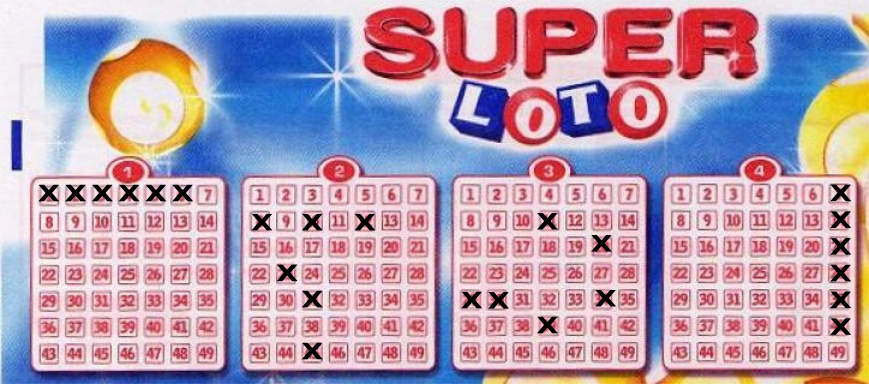
"if you want to lose, choose that one!"
has to do with their probability after all! One just need to change the concept of probability 🤨.

We are not amazed by the white surface of a whiteboard! Simplicity is only perceived as improbable if it is unexpected.
based on Algorithmic Information Theory
is found to match people’s intuitive probability judgments.
- Dessalles, J.-L. (2006). A structural model of intuitive probability. In D. Fum, F. Del Missier & A. Stocco (Eds.), ICCM-2006, 86-91. Trieste, IT: Edizioni Goliardiche.
- Dessalles, J.-L. (2013). Algorithmic simplicity and relevance. In D. L. Dowe (Ed.), Algorithmic probability and friends - LNAI 7070, 119-130. Berlin, D: Springer Verlag.
- Saillenfest, A. & Dessalles, J.-L. (2015). Some probability judgements may rely on complexity assessments. COGSCI-2015, 2069-2074.