Understanding Artificial Intelligence
through Algorithmic Information Theory
Morphological Analogies
- semantic analogy: "king is to queen as man is to woman"
- morphological analogy: "king is to kings as queen is to queens"
rosa : rosam :: vita : x
Source: transformation of "rosa" into "rosam".Possible interpretation: add letter "m" at the end of the radical.Target: the same transformation may apply to the target ("vita"). The result would be x = "vitam". BUT other transformations are also possible (for instance: always answer "rosam")
Can we compute the ‘correct’ transformation?
let, ?0 : ?0, m, let
mem, ?0 = rosa
::
mem, ?0 = vita line 1: define a function based on a variable ?0 that adds m to it
line 2: Call this function with variable ?0 = rosa
line3: Move to the second half of the analogy
line 4: Call this function with variable ?0 = vita
rosa : rosam :: vita : x
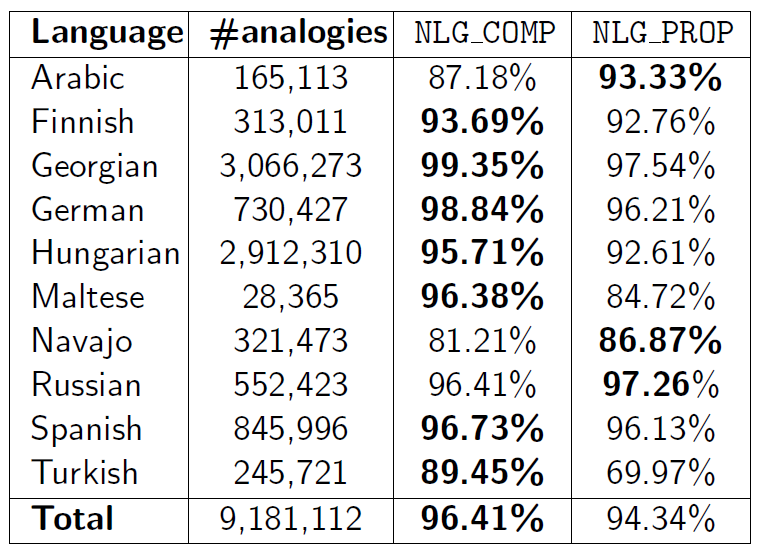
And it works!The algorithm has been used to guess the fourth term of morphological analogies.
Our algorithm based on minimum of complexity (here named NLG_COMP) favourably compares with a state-of-the-art method NLG_PROP (Fam & Lepage, 2018) on the dataset SIGMORPHON’16 . . .