Understanding Artificial Intelligence
through Algorithmic Information Theory
Detecting Language Proximity through Compression
 Intuitively, two texts T1 and T2, considered as mere strings, should share more information if they are written in the same language
than when compared with a third text T3 written in a different language.
 This is due to the greater redundancy if X and Y share many words.
Conditional complexity is the most natural way to measure information sharing. We expect: C(T1 | T2) << C(T1 | T3)
Using the Chain Rule, we can write: C(T1 | T2) > C(T1, T2) – C(T2)
Measuring the output of compressor Z as proxy for C and text concatenation instead of conjunction, we can estimate C(T1 | T2) by: length(Z(T1 + T2)) – length(Z(T2))
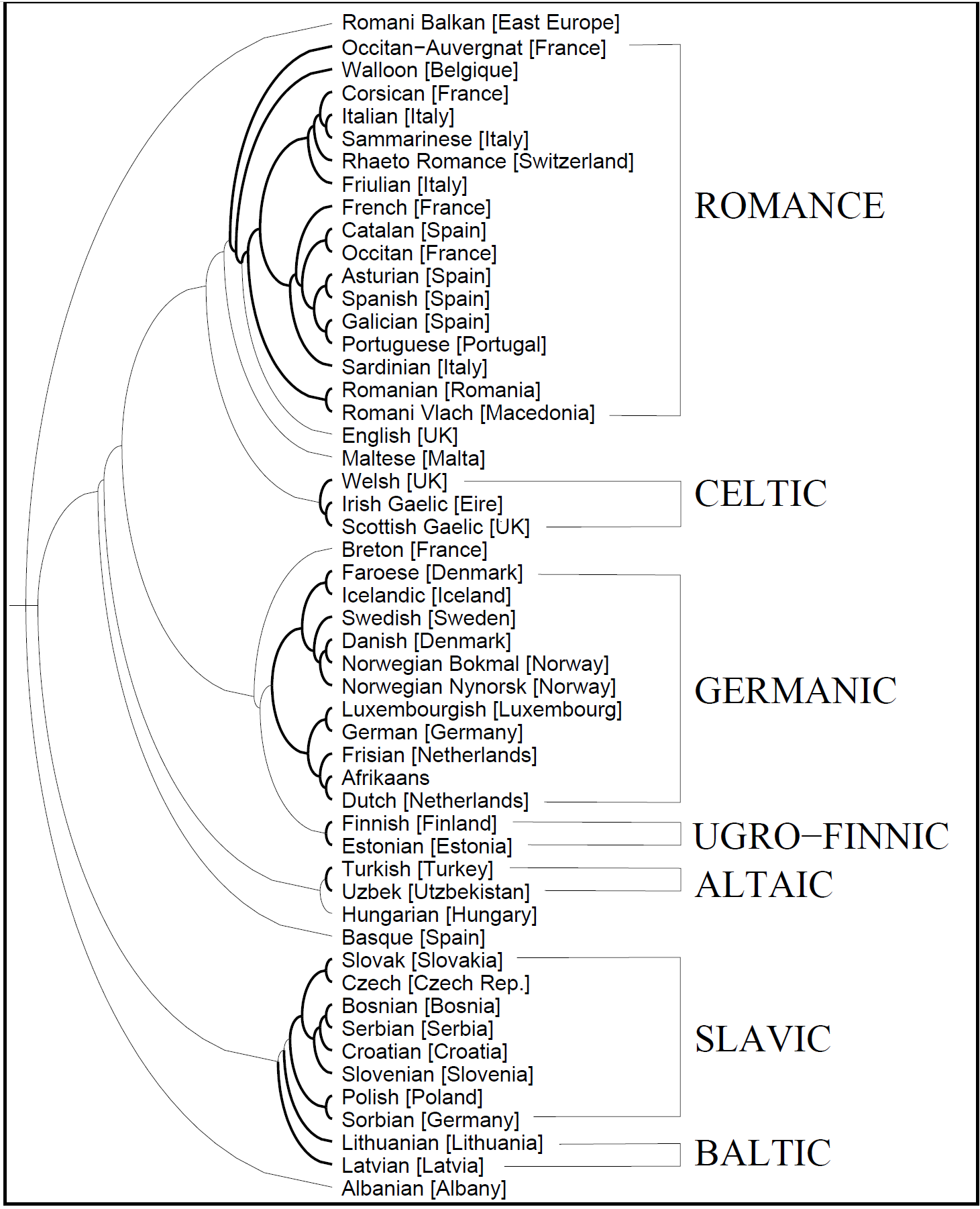 In 2002, three scientists, Dario Benedetto, Emanuele Caglioti and Vittorio Loreto, were able to measure language proximity using a mere compressor such as Zip.
The language tree they could reconstruct with this estimate of conditional complexity matches the main language families that linguists stepwise developed during a century!
You might notice a couple of miclassifications, though.