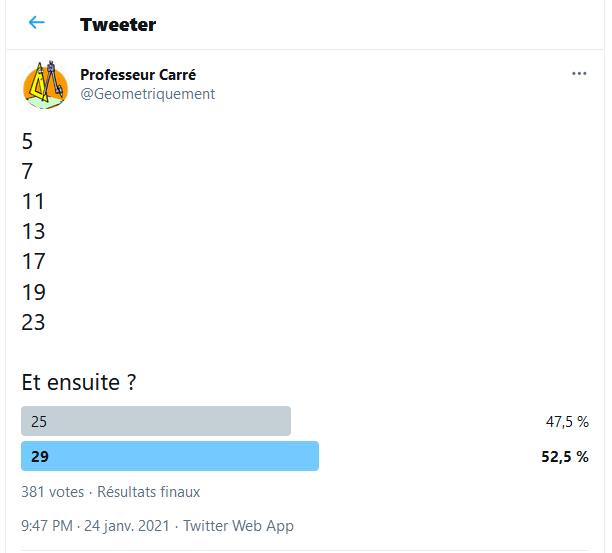
 I saw a funny thing on Twitter. |
|
What does it say? |

|
|

|
|
It asks what comes after 5, 7, 11, 13, 17, 19, 23.
There are two options: 25 and 29. |
|
I can see that people hesitate:
It’s almost half-half! I don’t understand why! |
|
|
|

|
|
Why what? |
|
There’s an obvious answer. |

|
|

|
|
Which is? |
|
You have to select the next prime, which is 29. |

|
|

|

Ha ha! You are reacting exactly as "MC Pablo"! |
|
It’s in French. |

|
|
|
|
So you didn’t see the pattern +2 +4 +2 +4 +2 +4. |
|
Ah! OK, I understand why 25 makes sense, now. |
|
|
|

|
|
So it’s clear which is the "correct" answer. |
|
Yes. You just choose the less complex one. |

|
|

|
|
And so you will favor 25, as the Turing machine that computes
+2, +4, +2, +4... is smaller than the one that computes prime numbers. |
|
No, I was about to say that 29 was simpler! |
|
|
|
|
|
You can’t say that! |
|
Yes I can! If you already know what primes numbers are, it’s simpler
to say "retrieve the next prime". |
|
|
|
|
|
Ok, I agree that the best induction depends on what you already know. |
|
Anyway, I had a look at what oeis.org says about this series.
"Numbers congruent to 1 or 5 mod 6",
"Numbers n such that (2n + 1)/3 is prime",
"nth irreducible polynomial over Q (with coefficients 0 or 1) evaluated at x=2". |
|
|
|
|
|
The first one is the same as +2, +4, +2... |
|
Yes, no... Not exactly. But anyway, the other ones are really crazy! |
|
|
|
|
|
You say this because they are way too complex, as compared with merely saying 5, 7, 11, 13, 17, 19, 23. |
|
Yes, I guess so.
Maybe complexity offers us a way to measure "craziness" 🤪! |
|
|
|
|