
|
Telecom Paris
Dep. Informatique & Réseaux  Nils Holzenberger
← Home pageFebruary 2024 |


3EL05: Algorithmic Information and A.I.Lecturer: Nils Holzenberger
Contents
Machine Learning and Algorithmic Information
Machine Learning and Algorithmic Information
The induction problem Induction is one of the oldest philosophical problem. And Algorithmic Information Theory solved it!As an example, we will show how Kolmogorov complexity can be used to make analogies. Minimum Description Length The most common way to perform induction in practice is called MDL: Minimum Description Length. Prototype-based models and compression The central topic of this chapter is that machine learning translates into compression.
This claim will be illustrated with prototype-based models.
Conversely, compression provides a criterion that can be used to guide machine learning. It is illustrated in the context of clustering. Anomaly detection Anomaly detection is an important and difficult topic of AI. Anomalies will be shown to be events that are abnormally simple. Universal induction Are you dreaming of an AI system that would beat us all? AIT offers precisely this, at least in principle.
- First as an ideal way to perform prediction, using what is called the universal distribution.
- Then as an ideal way to perform action: we will briefly consider AIXI, an ideal version of reinforcement learning based on algorithmic information.
[Close]
What you will learn in this chapter
- a criterion to make optimal hypotheses in learning tasks,
- a method to solve analogies,
- a new way to detect anomalies,
- a new understanding of machine learning as a way to achieve compression,
- a method to define an unbeatable AI.
The induction problem
Understanding Artificial Intelligence
through Algorithmic Information Theory
Induction:
A fundamental component of Intelligence
- learn
- recognize situations
- detect new structures
- make appropriate decisions
- and much more.
All humans are mortal.
Socrates is human.
Therefore Socrates is mortal.
Will it rain tonight?

For this, deduction proves insufficient.
How can we extract general rules from limited data?
What symbol should come next? Possible solutions:
- 6: because sequence of integers
- 7: because numbers k such that (7 × 10k + 71)/3 is prime.
- 1: because repetition of the sequence 12345
- 42: because roots of polynomial
x6 – 57x5 + 715x4 – 3795x3 + 9724x2 – 11628x + 5040
Or in other words: continue the sequence
(rain, rain, sun, rain, rain, sun, snow, mist, rain, rain) Classification: Having observed a sequence of pairs (object, label), can I predict the label of a new object?
Or in other words: continue the sequence
(object 1, label 1, object 2, label 2, ... , object n, label n, object n+1)
 Epicurus 341–270 BCPrinciple of multiple explanations:
If more than one theory is consistent with the observations, keep all theories.
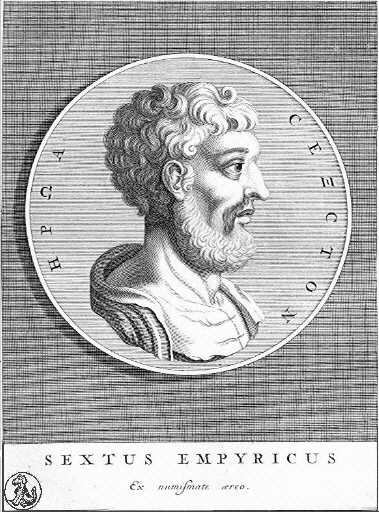 Sextus Empiricus 160-210Validity of inductive reasoning:
‟When proposing to establish the universal from the particulars [...] induction will be insecure, since some of the particulars omitted in the induction may contravene the universal; while if one is to review all, one will be toiling at the impossible, since the particulars are infinite and indefinite.”

|
 |
| "some of the particulars omitted in the | induction may contravene the universal" |
|
 |
 William of Ockham 1287-1347Occam’s Razor Principle:
Entities should not be multiplied beyond necessity
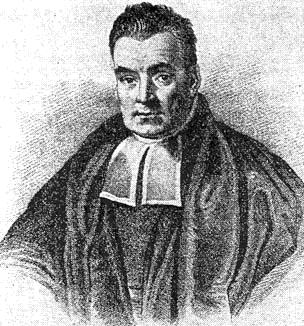 Thomas Bayes 1701-1761Bayes’ Rule:
The probability of hypothesis H being true given some data D is proportional to the learner’s prior belief in H multiplied by the conditional probability of D given H.
- Principle of multiple explanations
- Validity of inductive reasoning
- Occam’s Razor Principle
- Bayes’ Rule
For ages, the problem of induction has been considered to have no general solution...
until 1964, when Ray Solomonoff solved it by creating
the Algorithmic Information Theory framework.
|
What is the odd object out in this list? cow, hen, pig, sheep.
This is a genuine induction problem: form a rule that covers most items (but happens to exclude one). |
| Why may some solutions be less relevant than others in the previous exercise? |
An illustration: Analogy making
Understanding Artificial Intelligence
through Algorithmic Information Theory
Analogy making
and complexity
 Why is analogical reasoning so fundamental?
- In mathematics and science: discover new concepts, or generalize notions to other domains
- Justice: use of relevant past cases
- Art: metaphors, parody, pastiche
- Advertising: similarity of products influence people
- Humour: jokes are often based on faulty analogies- teaching, XAI: good explanations are often analogies
- transfer learning: transfer of expertise to new domain
- Gills are to fish as lungs are to humans.
- Donald Trump is to the US as Vladimir Putin is to Russia
- Donald Trump is to Barack Obama as Barack Obama is to George Bush
- 37 is to 74 as 21 is to 42
- The sun is to Earth as the nucleus is to the electron
A is to B as C is to D
is also noted: A : B :: C : D
If R is a relation that holds between A and B: R(A,B)
then the analogy says that the same relation holds between the two pairs: R(A,B) and R(C,D). Understanding an analogy means:
find the most appropriate relation R
A : B :: C : D
Following (Cornuejols, 1996; Cornuejols & Ales-Bianchetti, 1998), we may say that "the most appropriate relation R" is the one that makes the quadruplet (A,B,C,D) simplestor, in other words,
the one that achieves the best compression. This is a special case of the induction principle.
A : B :: C : D
Such an analogy 𝒜 is often considered to obey the following axioms:- identity: 𝒜(A,B,A,B)
- symmetry: 𝒜(A,B,C,D) ⇒ 𝒜(C,D,A,B)
- central permutation: 𝒜(A,B,C,D) ⇒ 𝒜(A,C,B,D)
We call analogical equation the problem of finding the missing term x in an analogy:
A is to B as C is to x
or: A : B :: C : x Examples:- Paris is to France as Helsinki is to ... ?
- ABC is to ABD as IJK is to ... ?
A : B :: C : x
Following the induction principle, solving the analogical equation amounts to finding \(\mathbf{x}\) such that:
\(\mathbf{x} = argmin(K(A, B, C, \mathbf{x}))\)
where K designates Kolmogorov complexity.
A : B :: C : x
Doug Hofstadter is well-known for his original study of analogy. Let’s consider one of his favourite examples.
abc : abd :: ppqqrr : x
Have you come up with a solution?
abc : abd :: ppqqrr : x
Most people would instantly answerx = ppqqss. Why should we consider it a "better" solution than, say, x = ppqqrd?
abc : abd :: ppqqrr : x
x = ppqqss. x = ppqqrd. We have to compare two rules:- increment the last item
- replace the last letter by d
The second rule has two drawbacks in terms of complexity:
- - it introduces a constant, d.
- - if we do not want to lose the structure that led to the compression of ppqqrr, the rule should read:
"break the last item back into letters, and replace the last letter by d"
Computing analogies
Let’s say you are studying Finnish and that you learn the verb puhua. You discover that the first person in the present tense of this verb is puhun. Now, you want to conjugate the verb nauraa in the same tense and in the same person. What do you suggest? The similarity of the structure lets you think that the answer is probably nauran. Congratulations! You are now able to conjugate the Finnish first group of verbs in the first person of the present tense! You can do it because you intuitively know how to process morphological analogies.
Understanding Artificial Intelligence
through Algorithmic Information Theory
Morphological Analogies
- semantic analogy: "king is to queen as man is to woman"
- morphological analogy: "king is to kings as queen is to queens"
rosa : rosam :: vita : x
Source: transformation of "rosa" into "rosam".Possible interpretation: add letter "m" at the end of the radical.Target: the same transformation may apply to the target ("vita"). The result would be x = "vitam". BUT other transformations are also possible (for instance: always answer "rosam")
Can we compute the ‘correct’ transformation?
let, ?0 : ?0, m, let
mem, ?0 = rosa
::
mem, ?0 = vita line 1: define a function based on a variable ?0 that adds m to it
line 2: Call this function with variable ?0 = rosa
line3: Move to the second half of the analogy
line 4: Call this function with variable ?0 = vita
rosa : rosam :: vita : x
And it works!The algorithm has been used to guess the fourth term of morphological analogies.
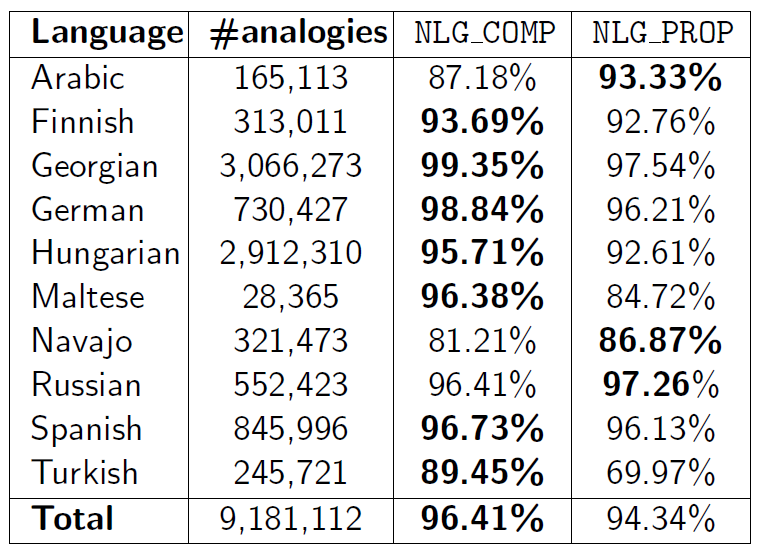
Our algorithm based on minimum of complexity (here named NLG_COMP) favourably compares with a state-of-the-art method NLG_PROP (Fam & Lepage, 2018) on the dataset SIGMORPHON’16 . . .
Computing morphological analogies
- A program in this language corresponds to a sequence of comma-delimited instructions.
- A sequence describes a series of concatenations. For instance, the program 'ab','cd' outputs the string abcd.
- The main characteristic of our language is the implementation of a memory as a push-down stack. At any time, an element can be stored into memory, using two let instructions (an opening one and a closing one). For instance, let, 'abc', let stores the string abc in memory.
- The operator mem is used to retrieve the last elements stored in memory. The ith last element stored in memory can be retrieved with the instruction mem, i. By convention, the index starts with 0 (which means that mem,0 retrieves the very last element saved in memory).
| Which would be the output of the program let,'ab',let,let,'cd',let,mem,1? |
- In addition, we allow the program to store operations in memory, in which case the parameters are denoted by ?n, where n is the index of the parameter. For instance, the instruction let, ?0, ?1, let stores an operation that concatenates its two operands.
| Which of the following programs defines an operation which duplicates a string and introduces a hyphen to separate the duplicates? |
| Which of the following programs will not raise a syntax error? |
$ python
>>> import analogy
>>> analogy.generate_string("abc, ijk")
>>> 'abcijk'
>>> analogy.generate_string("let, ?0, -, ?0, let, mem, 0, orang")
>>> 'orang-orang'
>>> analogy.instruction_complexity("let, ?0, -, ?0, let, mem, 0, orang")
>>> 59
The program estimates this complexity through the function instruction_complexity(instruction_string) which takes as argument the instruction as a string.
| Select all programs that generate the string: rosa:rosam. |
| Based on the estimates of analogy.py, how complex is the less complex among these programs? |
$ python
>>> import analogy
>>> analogy.restricted_search('rosa:rosam::vita:vitam')
Best instruction: let,?0,a,:,?0,a,m,let,mem,0,ros,::,mem,0,vit
Expected result: vitam
Obtained result: vitam
Be careful: though the exploration space is restricted, the exploration can still take some time, especially if you ask for difficult analogies!
|
Execute the code to solve an analogy in Finnish:
puhua:puhun::katsoa:katson.
Which instruction do you get as a result? |
|
Does the restricted_search method work in all cases?
Does it work on analogies such as "abc:abd::ijk:ijl" (known as Hofstadter’s analogies)? Can you explain why? |
| Can you think of analogies in your mother tongue (or in any language you know) that won’t work with this method? |
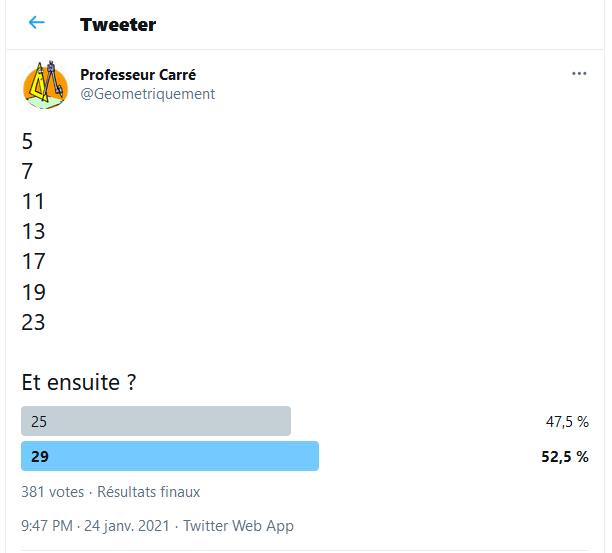 I saw a funny thing on Twitter. |
What does it say? | |
|---|---|---|
 
|
 
|
| It asks what comes after 5, 7, 11, 13, 17, 19, 23. There are two options: 25 and 29. | I can see that people hesitate: It’s almost half-half! I don’t understand why! | |
|---|---|---|
|
|

|
| Why what? | There’s an obvious answer. | |
|---|---|---|

|

|
| Which is? | You have to select the next prime, which is 29. | |
|---|---|---|

|

|

Ha ha! You are reacting exactly as "MC Pablo"! |
It’s in French. | |
|---|---|---|

|
|
| So you didn’t see the pattern +2 +4 +2 +4 +2 +4. | Ah! OK, I understand why 25 makes sense, now. | |
|---|---|---|
|
|

|
| So it’s clear which is the "correct" answer. | Yes. You just choose the less complex one. | |
|---|---|---|

|

|
| And so you will favor 25, as the Turing machine that computes +2, +4, +2, +4... is smaller than the one that computes prime numbers. | No, I was about to say that 29 was simpler! | |
|---|---|---|
|
|
|
| You can’t say that! | Yes I can! If you already know what primes numbers are, it’s simpler to say "retrieve the next prime". | |
|---|---|---|
|
|
|
| Ok, I agree that the best induction depends on what you already know. |
Anyway, I had a look at what oeis.org says about this series.
"Numbers congruent to 1 or 5 mod 6", "Numbers n such that (2n + 1)/3 is prime", "nth irreducible polynomial over Q (with coefficients 0 or 1) evaluated at x=2". |
|
|---|---|---|
|
|
|
| The first one is the same as +2, +4, +2... | Yes, no... Not exactly. But anyway, the other ones are really crazy! | |
|---|---|---|
|
|
|
| You say this because they are way too complex, as compared with merely saying 5, 7, 11, 13, 17, 19, 23. |
Yes, I guess so.
Maybe complexity offers us a way to measure "craziness" 🤪! |
|
|---|---|---|
|
|
|
Minimum Description Length (MDL)
In what follows, we present a version of MDL that we will call "ideal MDL" (which is very close to MML).
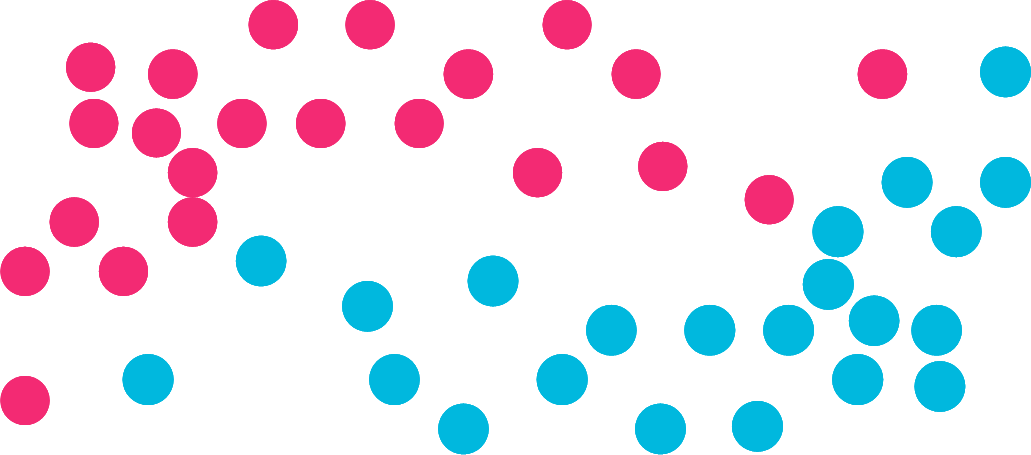
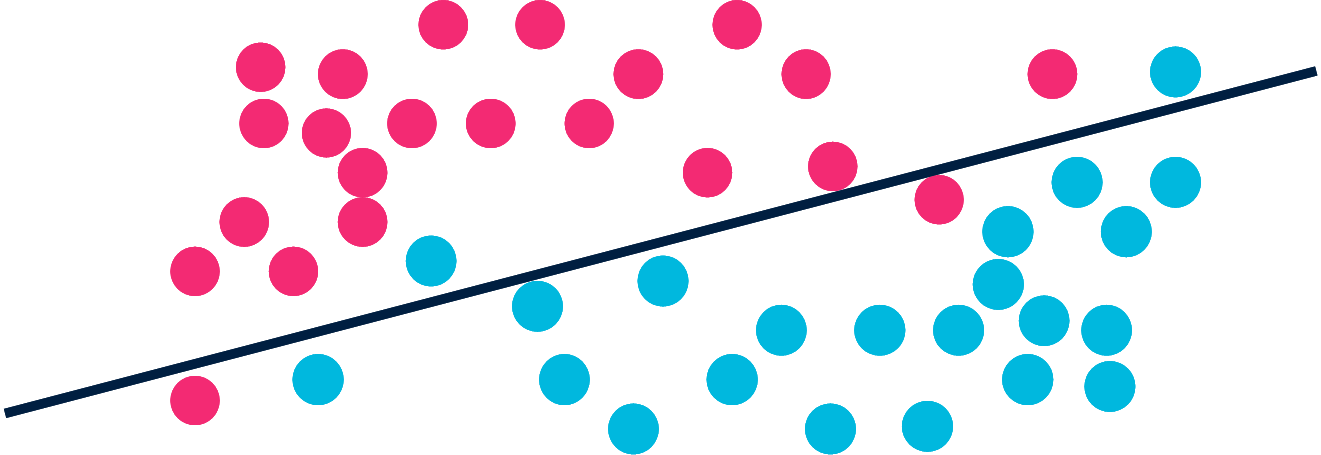
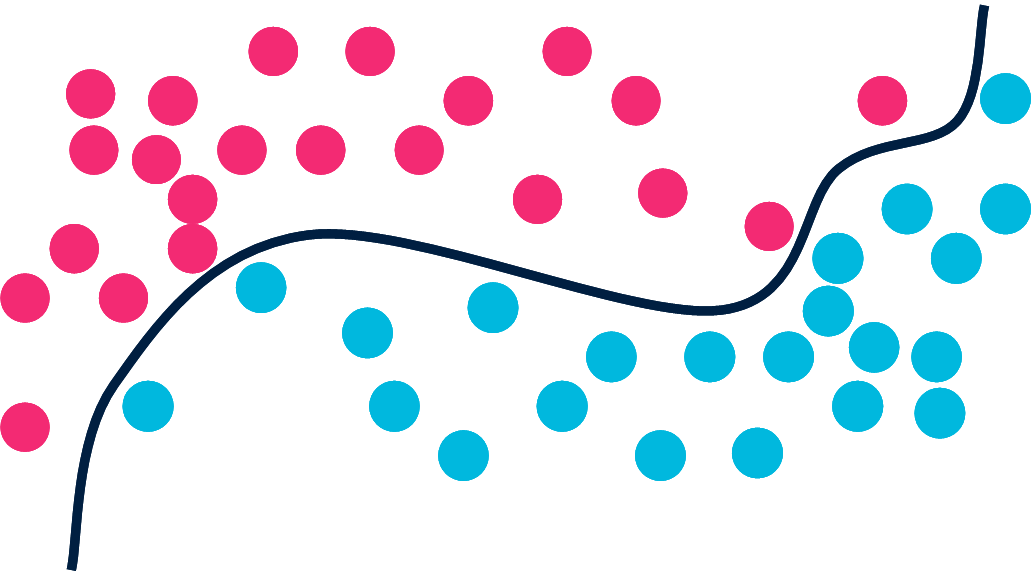
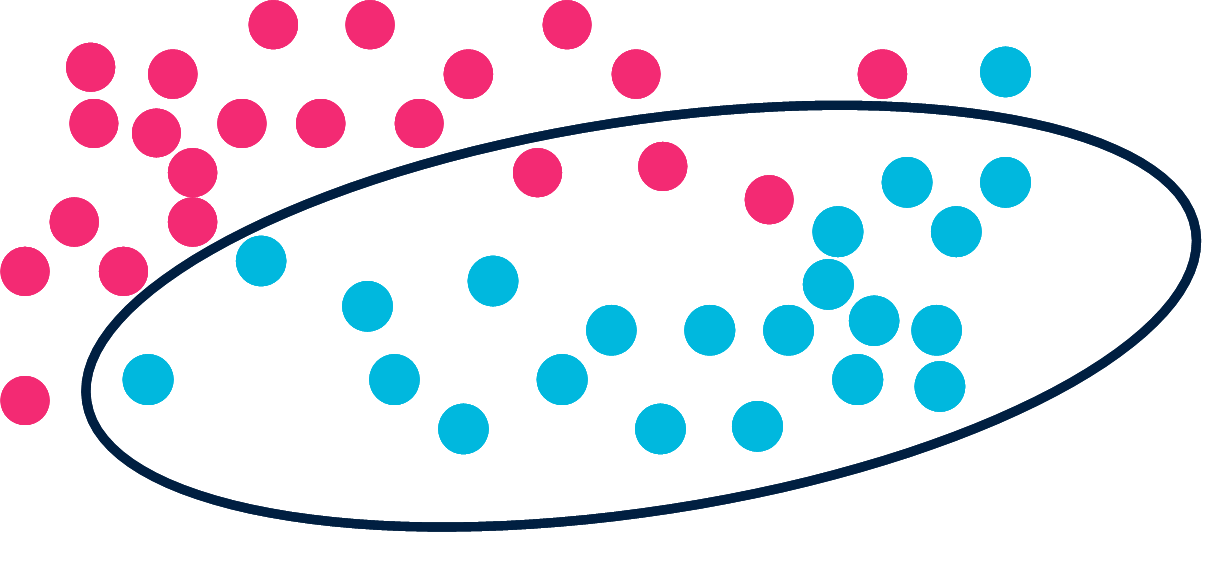
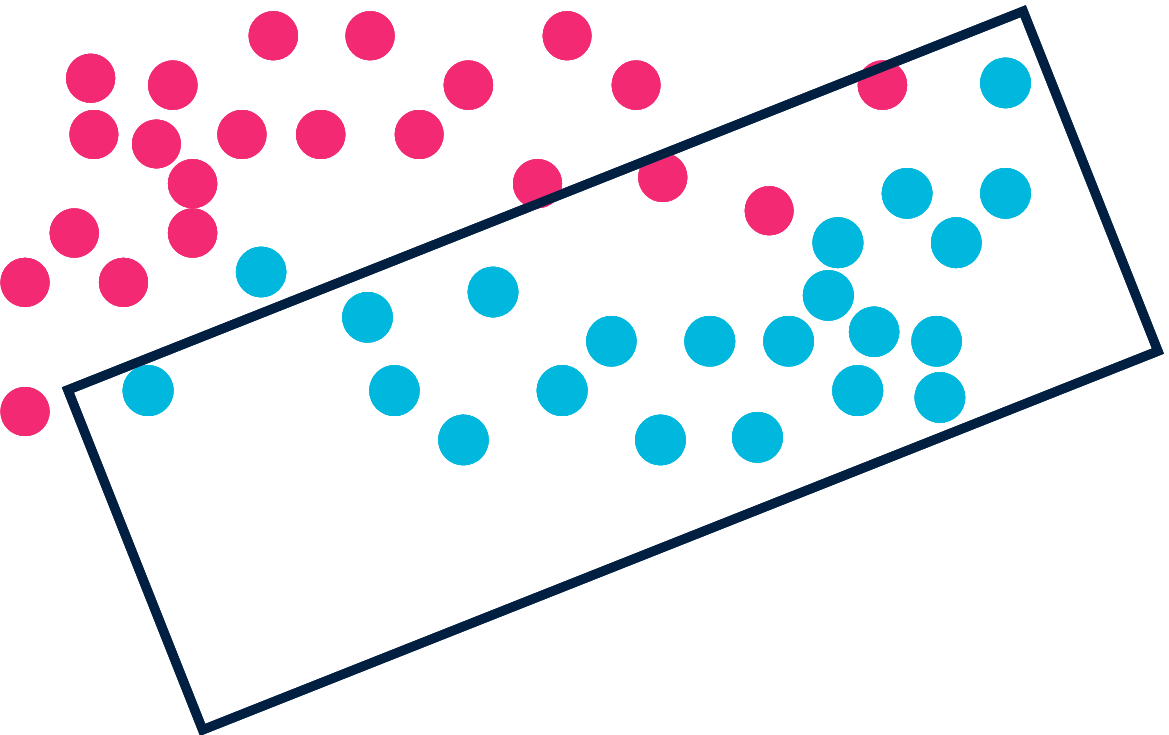
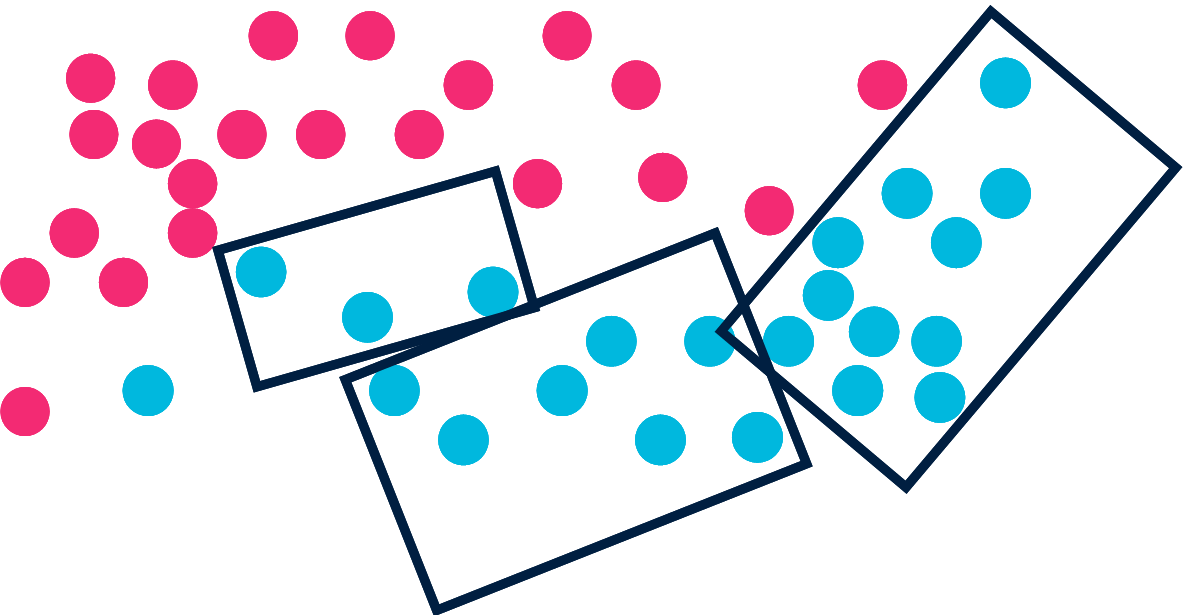 According to the (ideal) Minimum Description Length principle, you should choose the model that achieves the best compromise between simplicity and accuracy:
(ideal) MDL principle
|
Suppose you don’t know the true category (blue or red) of the \(N\) objects.
Among how many different classifications should we search the correct one? |
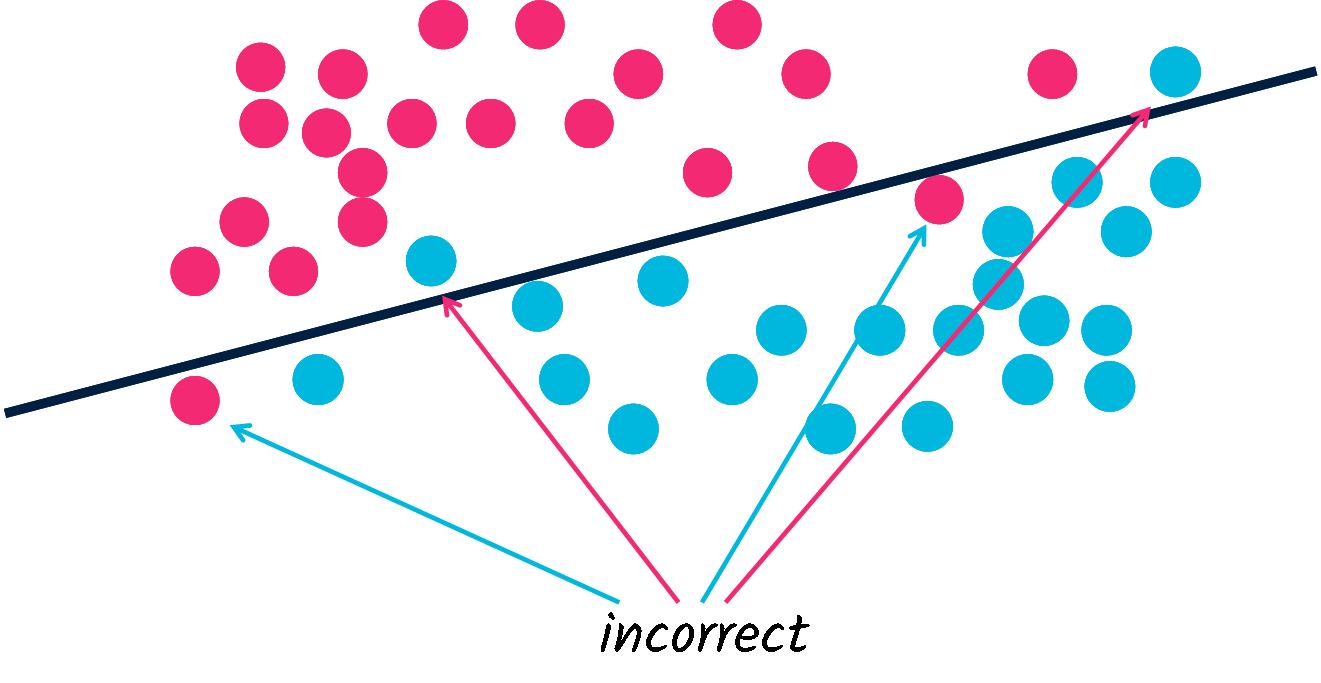 Algorithmic Information Theory describes the learning task as a compression operation. The "null model" M0 consists of remembering the class of each object. It requires N bits (1 bit for each element to be labelled as red or blue). We may take this as a baseline.
The different models Mi are attempts to classify the data in a more economic way. In other words, the MDL problem consists of choosing among the {Mi} the model that leads to maximal overall compression.Maybe Mi is not perfect, which means that Mi classifies only ni items among the {xk} correctly. We want to decide which is the "best" Mi.
| What is the compression (in number of bits saved by comparison with the null model) if \(M_i\) is perfect (\(n_i = N)\)? |
| How much worse (in number of bits) is the compression of an imperfect model, as compared with the perfect case? |
| Can you provide a formal characterization of the best model in the \({M_i}\) family? |
| Can you describe how the worst model behaves (if we ignore its own complexity)? |
(Gregory Chaitin, 2004)
- Chaitin, G. J. (2004). On the intelligibility of the universe and the notions of simplicity, complexity and irreducibility. In W. Hogrebe & J. Bromand (Eds.), Grenzen und Grenzüberschreitungen, XIX, 517-534. Berlin: Akademie Verlag.
- Maldacena, J. (2015). The symmetry and simplicity of the laws of physics and the Higgs boson. European Journal of Physics, 37 (1), 015802.
- Piantadosi, S. T. (2018). One parameter is always enough. AIP Advances, 8 (9).
Prototype-based models and compression
Understanding Artificial Intelligence
through Algorithmic Information Theory
Prototype based models
and compression
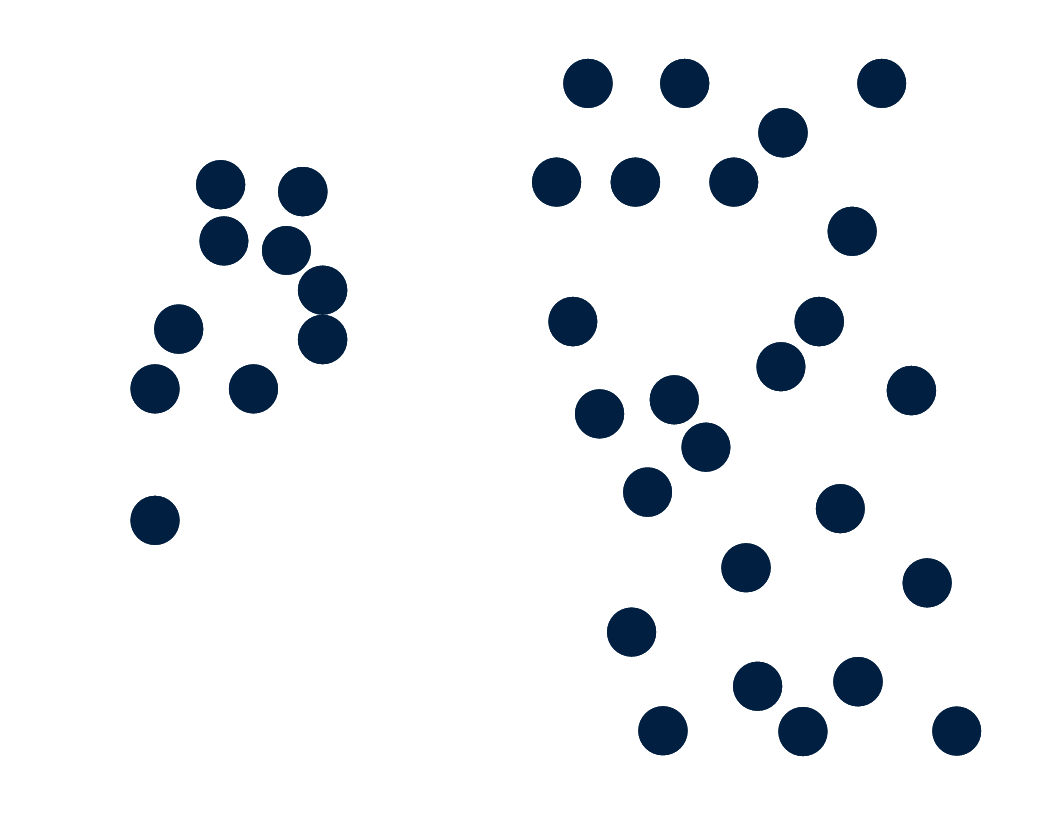 Prototype-based models
 can be used in unsupervised learning to group similar data points together (e.g. in marketing or recommender systems).
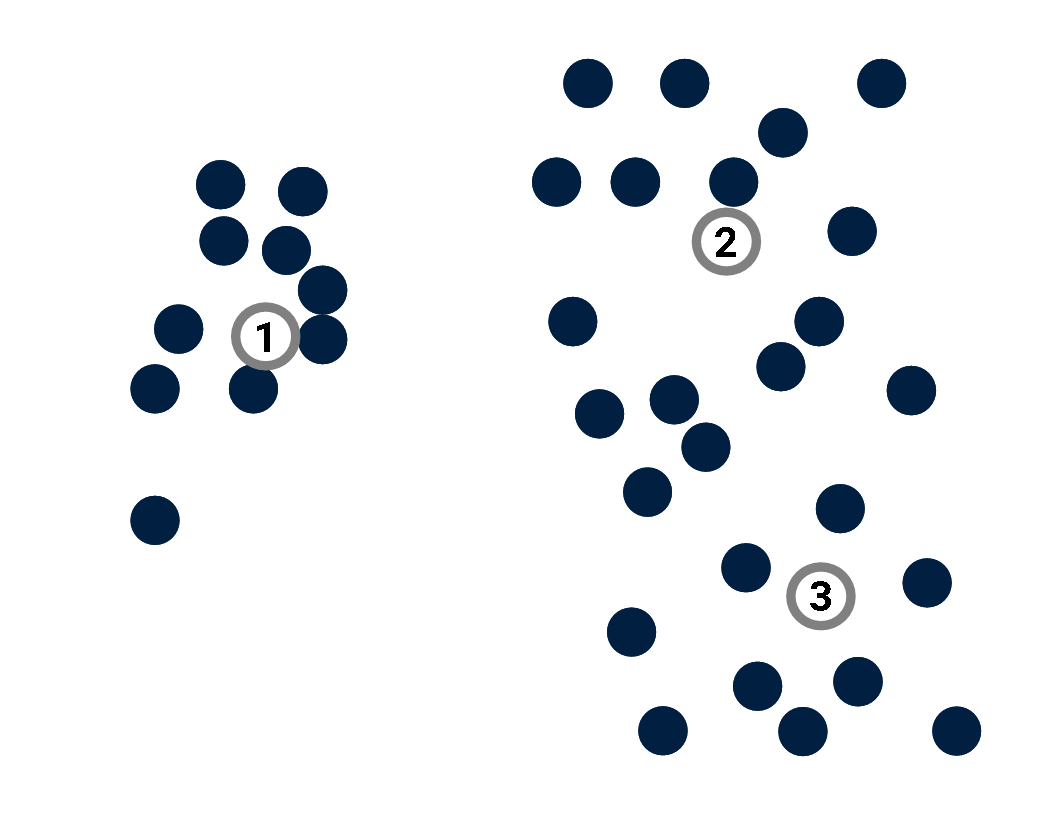 Prototype-based models
 can be used in unsupervised learning to group similar data points together.A prototype is a point of the input space used to provide information about the distribution of data points.
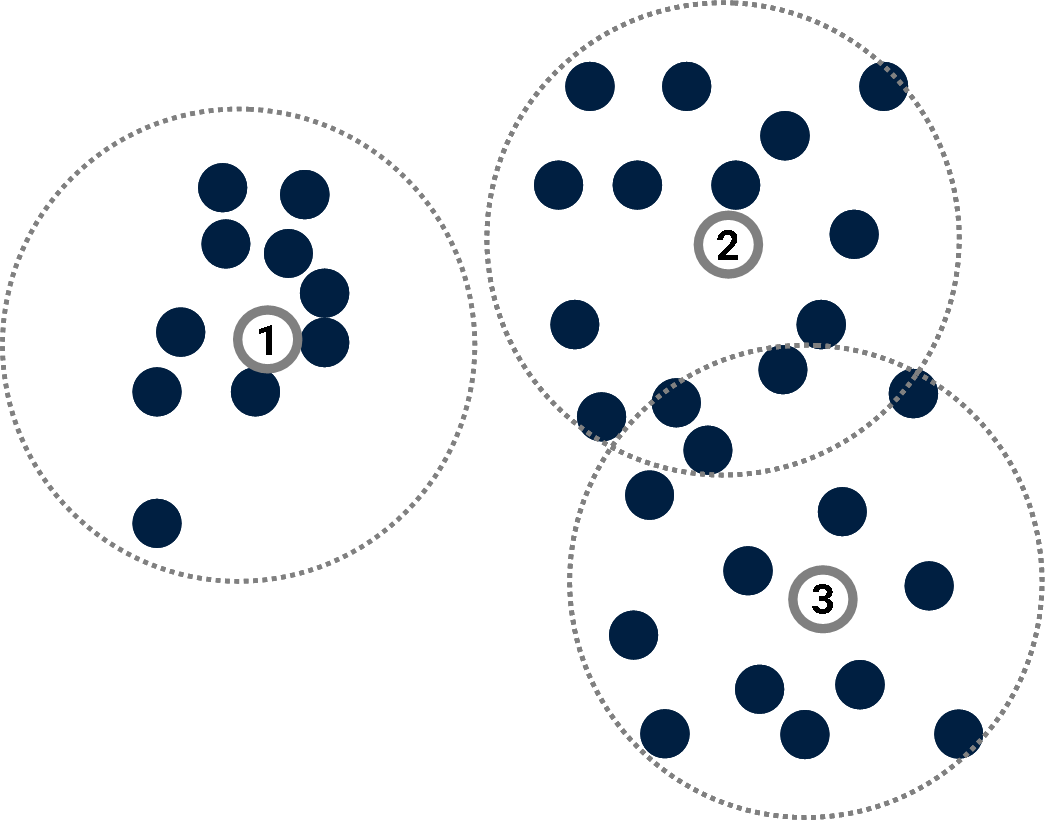 Prototype-based models
 can be used in unsupervised learning to group similar data points together.A prototype is a point of the input space used to provide information about the distribution of data points. Intuitively, data are distributed "around" the prototypes.
Prototypes models
One of the most famous prototype-based methods in machine learning is the K-Means algorithm.
Several improvements have been proposed (Learning Vector Quantization, Online Learning Vector Quantization, Self-Organizing Maps, Neural Gas algorithms, etc.).
Prototypes models
One of the most famous prototype-based methods in machine learning is the K-Means algorithm. You can watch nice Neural Gas demos

|
here |
|
|
and there |
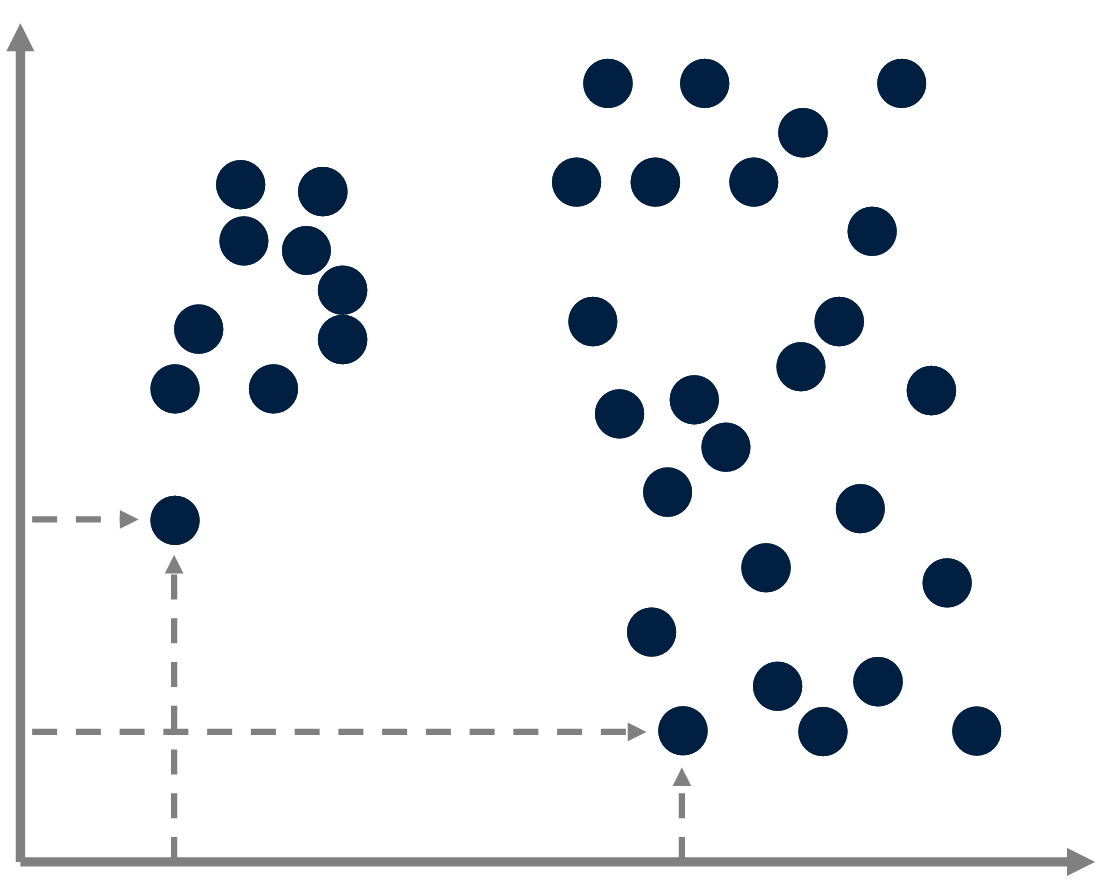 Compression
Prototype-based models can be seen as compression methods: Instead of describing data points by specifying their absolute coordinates,
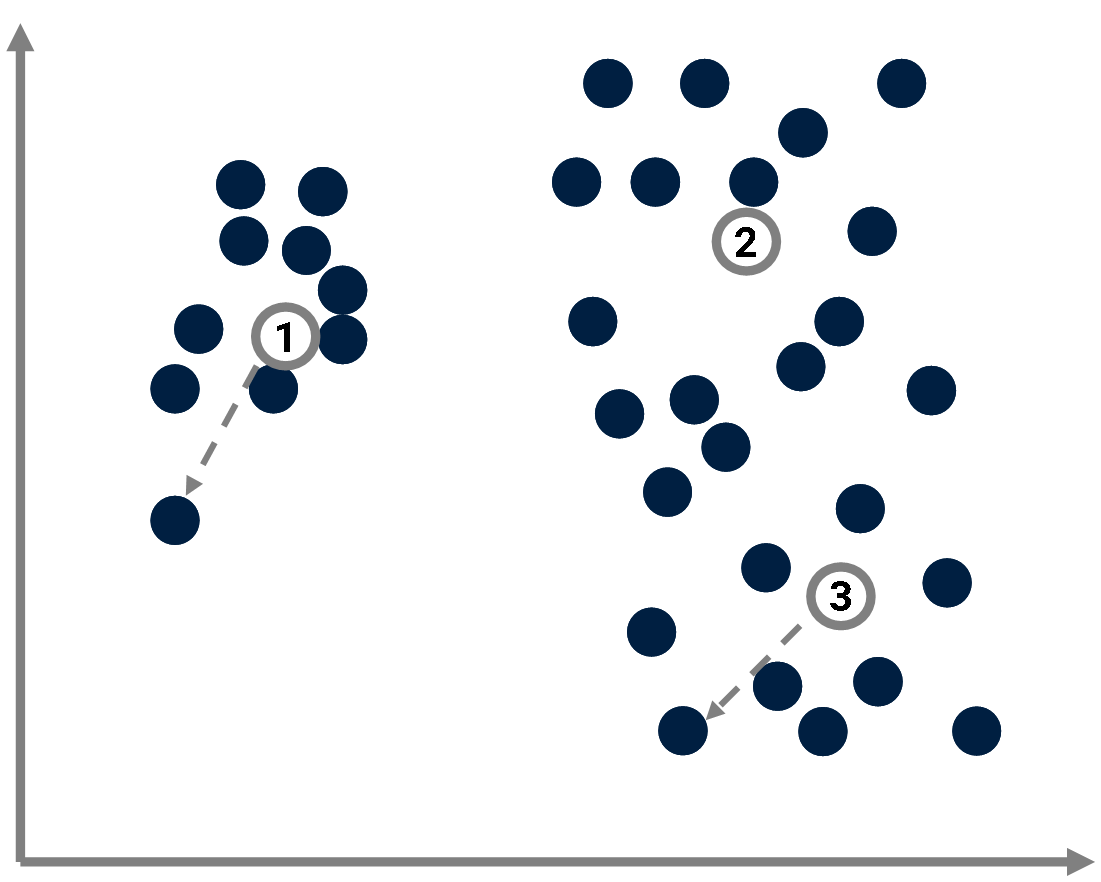 Compression
Prototype-based models can be seen as compression methods: Instead of describing data points by specifying their absolute coordinates,
one considers their coordinates relative to the closest prototype.
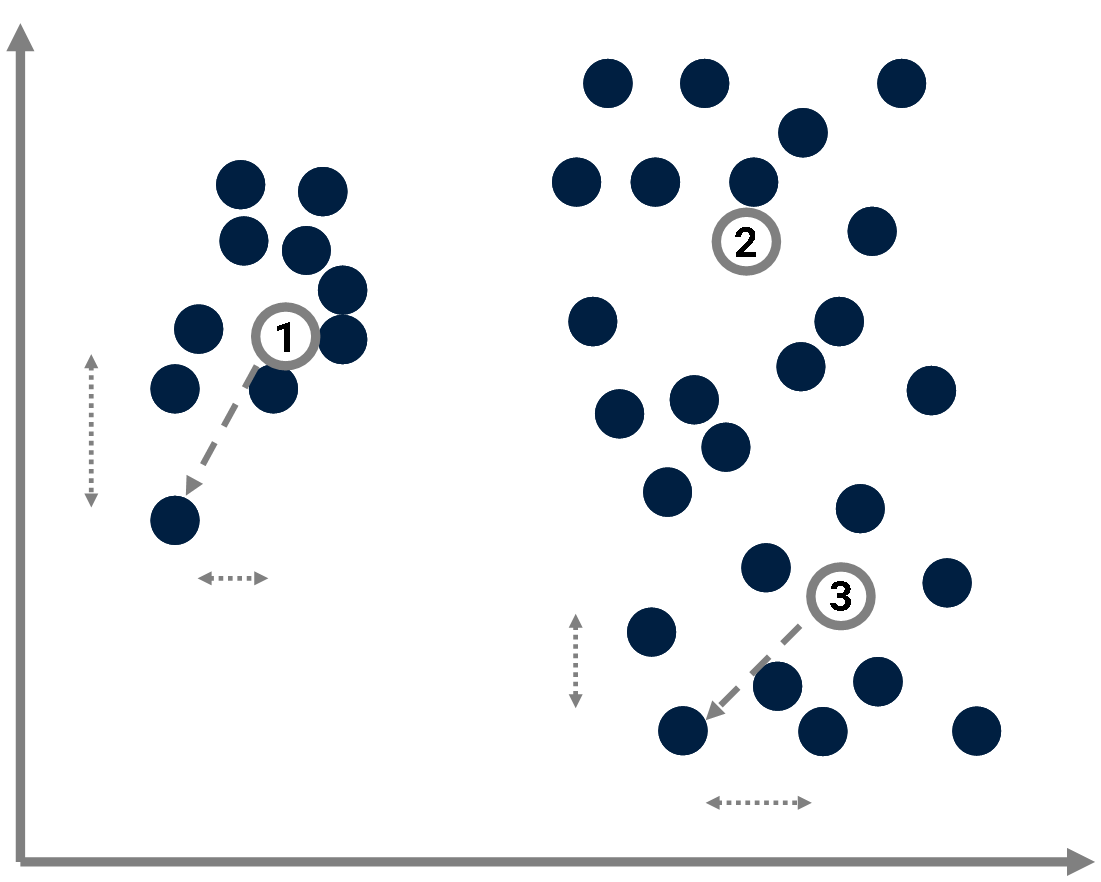 Compression
Prototype-based models can be seen as compression methods: Instead of describing data points by specifying their absolute coordinates,
one considers their coordinates relative to the closest prototype. We get smaller numbers, hence the compression.
Compression
The complexity of a point \(x_j\) in the dataset \(X\) is bounded by the complexity of its coordinates \((x_{j_1}, \dotsc, x_{j_d})\):
$$ C(x_j) \leq C(x_{j_1}) + \dotsc + C(x_{j_d}).$$
where the complexity of coordinates depends on the precision \(\delta\) used to convert them into integers.
We get a "naive" upper bound of the complexity of the whole dataset \(X\): $$C(X) \leq \sum_j C(x_j).$$
Compression
If prototypes \(\{p_k\}\) are introduced,
the complexity of \(X\) is now:
$$ C(X) \leq \sum_k C(p_k) + \sum_i C(x_j|\{p_k\})$$
where:
\(C(x_j|\{p_k\}) = \min_k C(x_j-p_k).\)
If the dataset exhibits some structure, suitable prototypes can be found and this estimate of \(C(X)\) will turn out to be significantly smaller that the "naive" one (hence the compression).
Conversely, and quite remarkably, this expression can be used to find the best prototype set \(\{p_k\}\)
(Cilibrasi & Vitányi, 2005). Classification
Now consider a classification task as an example of supervised learning.
The problem is to associate a label (e.g. blue/red/dark) to each data point.
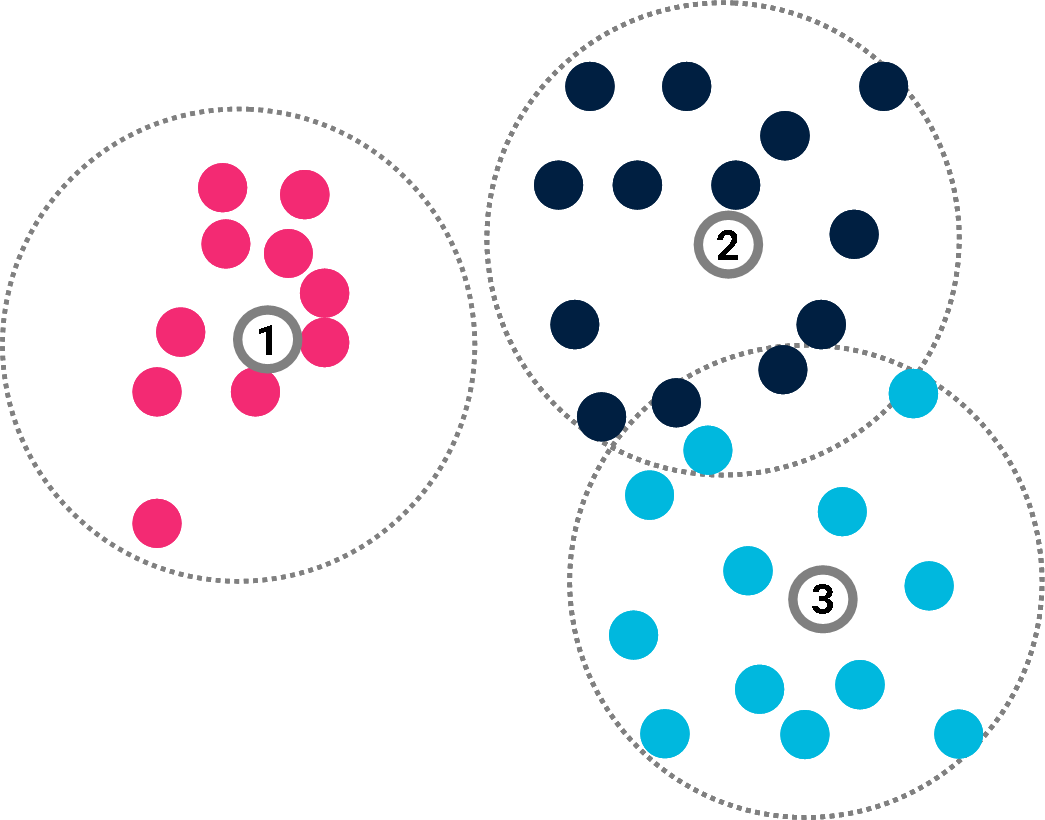 Classification
Now consider a classification task as an example of supervised learning.
The problem is to associate a label (e.g. blue/red/dark) to each data point.Prototype-based models are routinely used for this. In doing so, they offer a compressed version of the classification.
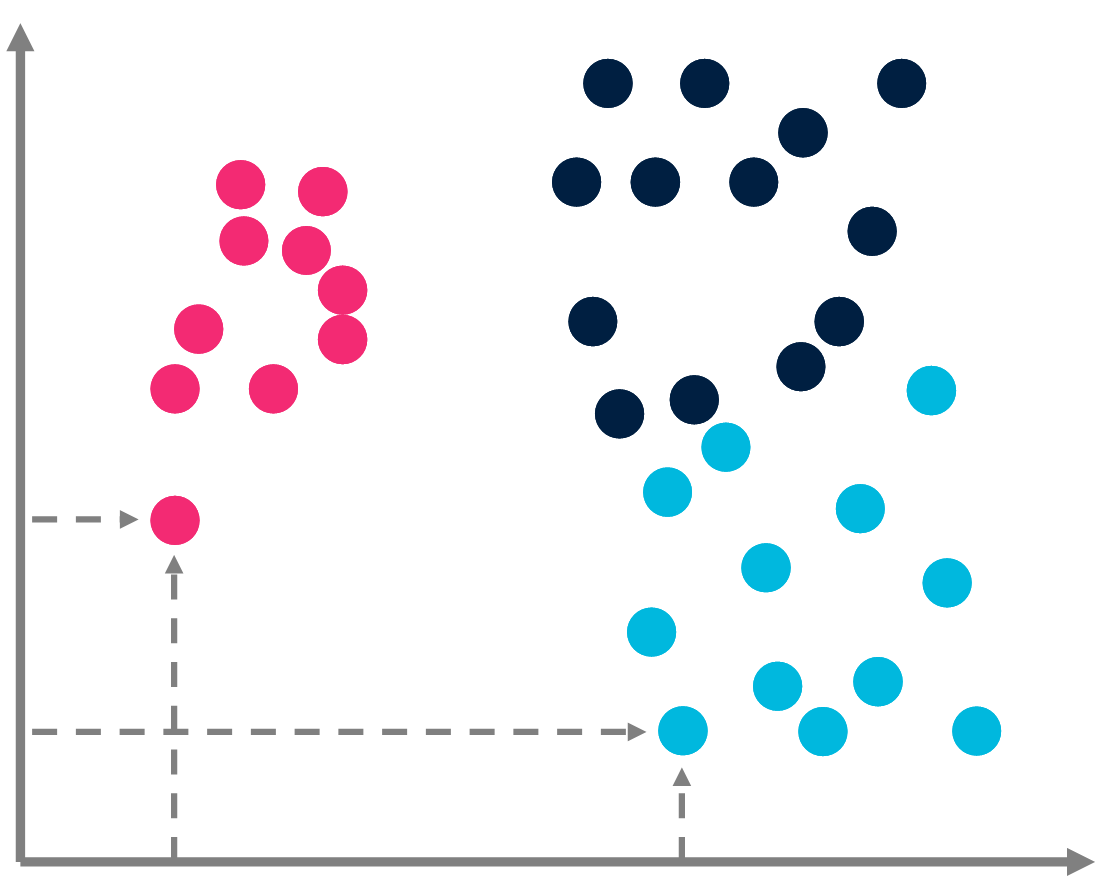 Classification
In a classification task, we consider a dataset \(X\) of \(|X|\) points \(x_j\). Each \(x_j\) is supposed to belong to a class labelled as \(y_j\). The problem is to learn which label \(y_j\) taken from the set of labels \(Y\) corresponds to \(x_j\).
The complexity of the classification is bounded by the amount of information required by rote learning.
$$C(\{(x_j, y_j)\} | X) \leq \sum_j C(\{y_j\}) \approx \sum_j |X| \times \log(|Y|)$$
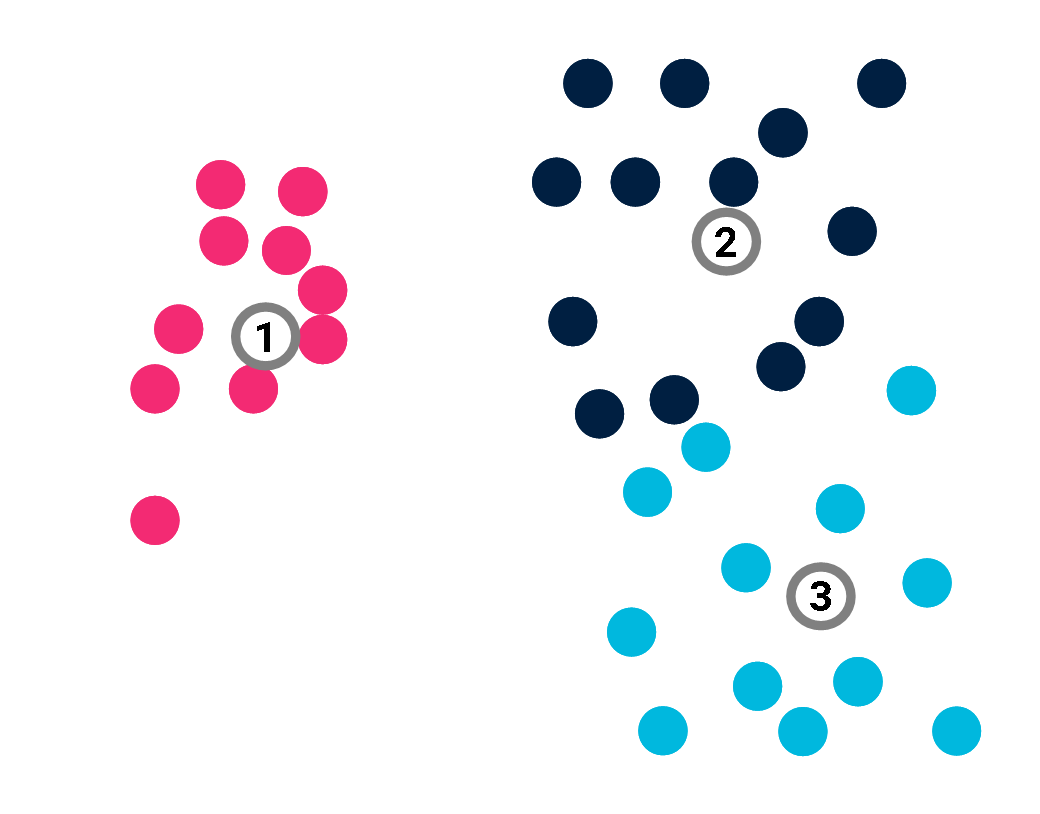 Classification
A prototype-based model \(\mathcal{M}\) would deduce the label of all points from those of its \(K\) prototypes \(\{p_k\}\), in the hope that:
$$\beta(x_i) = y_i$$
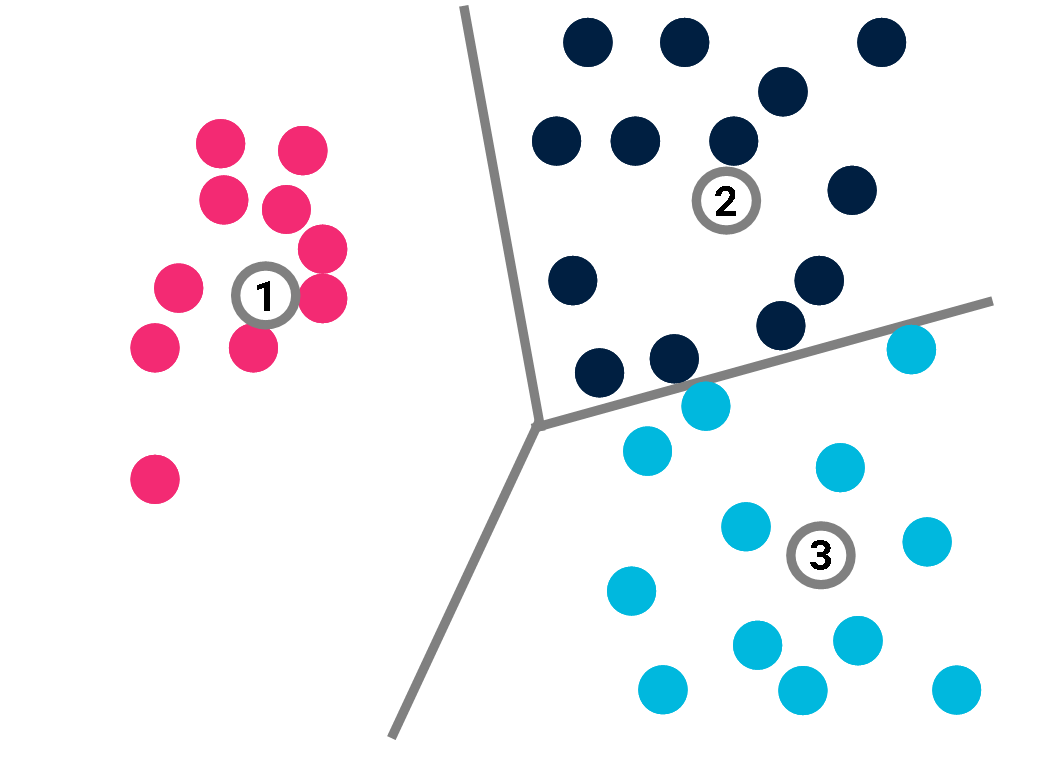 Classification
A prototype-based model \(\mathcal{M}\) would deduce the label of all points from those of its \(K\) prototypes \(\{p_k\}\), in the hope that:
$$\beta(x_i) = y_i$$
The decision function \(\beta\) just returns the label of the closest prototype.
For instance, if the point is closer to prototype 3 (labeled "blue") than to any other prototype, the decision function will return "blue".
Classification
The complexity of the model is given by the complexity of its prototypes and their labels:
$$C(\mathcal{M}) \leq \sum_k C(p_k) + K \times \log (|Y|).$$
Now:
$$C(\{(x_j, y_j)\} | X) \leq C(\mathcal{M}) + \sum_{i,j} {C((x_j, y_j)} | X, \mathcal{M})$$
Since the decision function \(\beta\) is just a loop over the prototypes,
\(C((x_j, y_j) | X, \mathcal{M}) = 0\). So \(C(\{(x_j, y_j)\} | X)\) is found to be much smaller if \(K \ll |X|\) than if we only rely on rote learning.
Classification
The complexity of the model is given by the complexity of its prototypes and their labels:
$$C(\mathcal{M}) \leq \sum_k C(p_k) + K \times \log (|Y|).$$
Now:
$$C(\{(x_j, y_j)\} | X) \leq C(\mathcal{M}) \ll \sum_j |X| \times \log(|Y|)$$
We just have to remember the prototypes and their label to retrieve all labels, hence the compression.
Classification
This is only true, however, if the model \(\mathcal{M}\) is perfect.
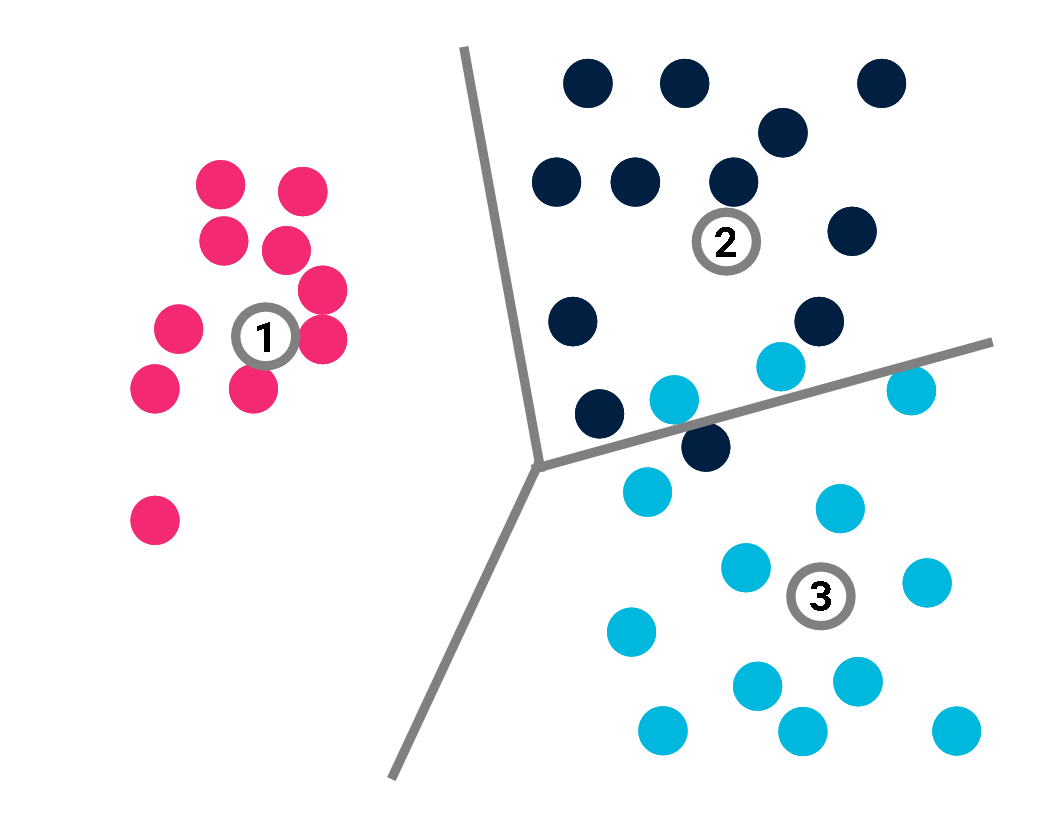 Classification
This is only true, however, if the model \(\mathcal{M}\) is perfect.If not:
\(C((x_j, y_j) | X, \mathcal{M}) \neq 0\).
For each misclassified point, we may just specify its index the correct value of its label.
$$C(\{(x_j, y_j)\} | X, \mathcal{M}) \leq \sum_{i=1}^{|X|} (C(i) + C(y_i)) \times \mathbb{I}(y_i \neq \beta(x_i))$$
where \(\mathbb{I}\) is a function that converts a Boolean value into 0 or 1.
Classification
This is only true, however, if the model \(\mathcal{M}\) is perfect.If not:
\(C((x_j, y_j) | X, \mathcal{M}) \neq 0\).More simply, if there are \(n\) misclassified points, we get:
$$\sum_{i,j} C((x_j, y_j) | X, \mathcal{M}) \leq n \times (\log(|X|) +\log(|Y|)).$$
Classification To sum up:
$$C(\{(x_j, y_j)\} | X) \leq \sum_k C(p_k) + K \times \log (|Y|) + n \times (\log(|X|) +\log(|Y|))$$
If \(n\) is small, this may still represent a huge compression as compared to rote learning.
The right-hand side of this inequality can be used as a loss-function to determine the best prototype-based classification.
| In what way do unsupervised prototype-based models achieve compression? |
| In what way does the supervised learning of classification achieve compression? |
Clustering and compression
The most popular clustering algorithm, called K-Means, is a prototype-based algorithm. The algorithm initializes random prototype positions and alternates two phases:
- it associates the data points to their closest prototype
- it moves the prototype position to the centroid of its associated data points.
Implementation
$ python Prototype.py
Iris dataset with 3 prototypes:
-------------------------------
>> prototypes found by K-Means:
[[5.9016129 2.7483871 4.39354839 1.43387097]
[5.006 3.428 1.462 0.246 ]
[6.85 3.07368421 5.74210526 2.07105263]]
>> Complexity reduction when using K-Means:
Dataset complexity: 1191
Complexity after K-Means: 219
The program computes complexity by adding the prototypes’ complexity and the complexity of the data points’ distances to the closest prototype (see the "basic complexities" section of the program). Choosing the right number of clusters is a well-known issue. If we apply the MDL Principle, the ideal number \(K\) of clusters should minimize the previous complexity. With too few clusters, the model is simple, but the complexity of the data knowing the model may be large; conversely, too many clusters would make the model unnecessarily complex and would produce overfitting.
|
Run the Prototype.py algorithm on the ‘Iris’ data set.
For which value of the number \(K\) of prototypes do we reach a minimum of complexity? |
|
Choose the ‘Diabetes’ data set. Data now have 10 dimensions (instead of 4 for ‘Iris').
What is the optimal value of \(K\) with respect to the MDL principle? (you may loop over increasing values of \(K\) up to 100) |
- Biehl, M., Hammer, B. & Villmann, T. (2016). Prototype-based models in machine learning. WIREs Cognitive Science, 7 (2), 92-111.
- Cilibrasi, R. & Vitányi, P. (2005). Clustering by compression. IEEE transactions on Information Theory, 51 (4), 1523-1545.
- Kleinberg, J. M. (2003). An impossibility theorem for clustering. In S. Becker, S. Thrun & K. Obermayer (Eds.), Advances in Neural Information Processing Systems 15 (NIPS 2002), 463-470.
|
I wonder how neural networks fit with this idea of
"learning = compression". |
They do more than rote learning. So they must achieve compression. | |
|---|---|---|
|
|
|
| Consider GPT-3, for instance. Its training resulted in the fitting of 175 BILLION parameters. You call it compression! | I guess, it all depends what you consider is compressed. | |
|---|---|---|
|
|
|
| Suppose you want to tell cats from dogs in a set of images. | Yes. There is one bit to be learned per image. | |
|---|---|---|
|
|
|
| If you must fit 60 millions parameters to decide on 1000 images, I don’t see the point. | In the paper that made Deep learning famous, there were 1000 categories, not just two. | |
|---|---|---|

|
|
| Maybe. That makes 10 bits per image. If you have 1000 images to categorize, that makes only 104 bits to learn. | The network was trained on 1.2 million images. | |
|---|---|---|
|
|
|
| Even so! 12 million bits against 60 million gradual parameters, I don’t see the compression. | But that’s not the point. You want to decide on unseen images. | |
|---|---|---|
|
|
|
| So what? | The point is that what you’ve learned with 60M parameters is potentially unbounded. The network can now categorize an infinity of different images. | |
|---|---|---|
|
|
|
| So, you mean that you compress an infinity down to "only" 60M parameters? |
Yes.
And in the case of GPT-3, ... |
|
|---|---|---|
|
|
|
| What about GPT-3? | Did you see that it is able to make up relevant answer to questions? | |
|---|---|---|
|
|
|
| Yes, that’s impressive! | One single relevant statement is worth a great deal of information, not just 10 bits. | |
|---|---|---|
|
|
|
| Why? | Because you need a certain amount of information to select that statement among all the possible silly ones in the current context. | |
|---|---|---|
|
|
|
| And so, according to you, it justifies the 175 billion parameters? | Indeed! It still achieves huge compression. | |
|---|---|---|
|
|
|
Anomaly Detection
What is an anomalY?
| Modify the anomalyDetection function in order to select abnormal points. A point is considered abnormal if the compression rate exceeds the threshold value. The function should return a list of indices. Use the numpy method where. Copy the ‘return’ line here. |
| Choose the dataset ‘diabetes’, and set the number of prototypes to the best value previously found. Uncomment the last lines to call anomalyDetection. Determine the threshold value that will select the 9 most abnormal points. Which value did you find? |
|
The preceding exercises aimed at detecting outliers.
What do you think...? |
- The threshold method is a little bit difficult to use in practice (which value of the threshold?). You could try to think of other methods to select abnormal points from the list of compression rates.
Lossless and lossy compression
More generally, lossy compression consists of discarding noisy or contingent data in the hope of capturing the gist of a phenomenon. An extreme form of lossy prototype-based compression would be to keep the prototypes and to forget all data. This amounts to keeping only the model part in the expression of MDL. Simplification and sketching (as in comic strips) may be modelled as resulting from lossy compression.
Note that such a simplification can only occur after the MDL optimization has been performed.In the next chapter, we will adopt the exact opposite perspective: situations in which only anomalies matter.
Interview
Recap
Take-home message
Let’s leave the last word to Angel@ and Alexandr@.
| This chapter on AIT and machine learning was nice, don’t you think? | Sure! I liked the idea that analogy is just a matter of minimizing complexity. | |
|---|---|---|
|
|
|
| Oh, it’s just a special case of induction. | No, I disagree. Analogy is a form of reasoning. | |
|---|---|---|
|
|
|
| Yes, but, induction is more general. I liked the last thing about universal induction and universal AI. | Yes, but it’s not computable. | |
|---|---|---|
|
|
|
| It helps me understand that efficient reinforcement learning depends on your ability to compute the future. | To me, analogy and MDL are closer to practical use. I like the idea of optimal trade-off between model simplicity and accuracy. | |
|---|---|---|
|
|
|
| And so you must be exited to see that any form of learning amounts to performing data compression. | Yes, we talked about that! | |
|---|---|---|
|
|
|
| Yeah. As for me, my favorite remains the idea that anomalies must be simple to characterize to be genuine anomalies. | Yes, that one also! | |
|---|---|---|
|
|
|
Bibliography
- Bayoudh, M., Prade, H. & Richard, G. (2010). A kolmogorov complexity view of analogy: From logical modeling to experimentations. In M. Bramer, M. Petridis & A. Hopgood (Eds.), Research and Development in Intelligent Systems XXVII. SGAI 2010, 93-106. London: Springer.
- Biehl, M., Hammer, B. & Villmann, T. (2016). Prototype-based models in machine learning. WIREs Cognitive Science, 7 (2), 92-111.
- Chaitin, G. J. (2004). On the intelligibility of the universe and the notions of simplicity, complexity and irreducibility. In W. Hogrebe & J. Bromand (Eds.), Grenzen und Grenzüberschreitungen, XIX, 517-534. Berlin: Akademie Verlag.
- Cilibrasi, R. & Vitányi, P. (2005). Clustering by compression. IEEE transactions on Information Theory, 51 (4), 1523-1545.
- Cornuéjols, A. (1996). Analogie, principe d’économie et complexité algorithmique. Actes des 11èmes Journées Françaises de l’Apprentissage. Sète, France: .
- Cornuejols, A. & Ales-Bianchetti, J. (1998). Analogy and Induction: which (missing) link?. Advances in analogy research: Integration of theory and data from the cognitive, computational, and neural sciences, 365-372. Sofia, Bulgaria: New Bulgarian University.
- Fam, R. & Lepage, Y. (2018). Tools for the production of analogical grids and a resource of n-gram analogical grids in 11 languages. Proceedings of the Eleventh International Conference on Language Resources and Evaluation (LREC 2018), 1060-1066.
- Hutter, M. (2001). Towards a universal theory of artificial intelligence based on algorithmic probability and sequential decisions. ECML-2001 (LNAI 2167), 226-238. Berlin: Springer.
- Hutter, M. (2005). Universal artificial intelligence: Sequential decisions based on algorithmic probability. Berlin: Springer.
- Hofstadter, D. R. (1995). Fluid concepts and creative analogies. New York: Basic Books.
- Kleinberg, J. M. (2003). An impossibility theorem for clustering. In S. Becker, S. Thrun & K. Obermayer (Eds.), Advances in Neural Information Processing Systems 15 (NIPS 2002), 463-470.
- Kolmogorov, A. N. (1983). Combinatorial foundations of information theory and the calculus of probabilities. Russian mathematical surveys, 38 (4), 29-40.
- Lepage, Y. (1998). Solving analogies on words: an algorithm. Proceedings of the 17th International Conference on Computational Linguistics, 728-734.
- Maldacena, J. (2015). The symmetry and simplicity of the laws of physics and the Higgs boson. European Journal of Physics, 37 (1), 015802.
- Miclet, L., Bayoudh, S. & Delhay, A. (2008). Analogical dissimilarity: definition, algorithms and two experiments in machine learning. Journal of Artificial Intelligence Research, 32 (), 793-824.
- Murena, P.-A., Al-Ghossein, M., Dessalles, J.-L. & Cornuéjols, A. (2020). Solving analogies on words based on minimal complexity transformation. International Joint Conference on Artificial Intelligence (IJCAI), 1848-1854. ➜ Watch the short video presentation.
- Piantadosi, S. T. (2018). One parameter is always enough. AIP Advances, 8 (9).
- Vitányi, P. (2013). Conditional Kolmogorov complexity and universal probability. Theoretical Computer Science, 501 (), 93-100.